
When Meta WhatsApp Cloud API sends an inbound message webhook, it expects your endpoint to return an HTTP 200 OK within 3,000 milliseconds. If your server stumbles, whether due to database thread pool exhaustion, vector similarity latency, or LLM inference delays, Meta interprets the request as timed out and initiates aggressive exponential retry storms.
During viral marketing drops, Black Friday promotions, or election broadcasts, an influx of 10,000 incoming customer messages in under two minutes will immediately bring down conventional synchronous Node.js applications.
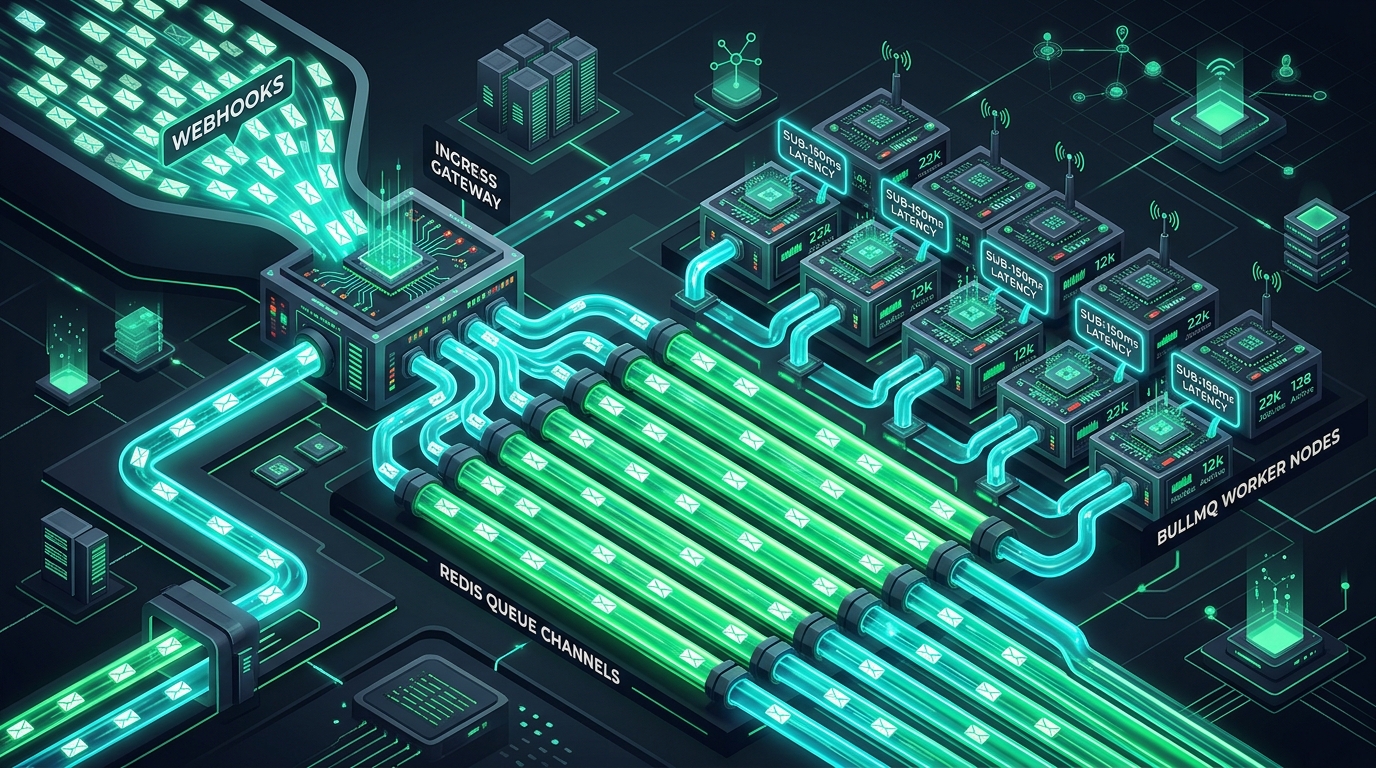
In this technical breakdown, we examine how DARA Cloud architectures its event-driven distributed queue pipeline using BullMQ and Redis Cluster to process 10,000 concurrent webhook events in under 150 milliseconds with 0% dropped packets.
1. The 3-Stage Decoupled Queue Topology
Rather than passing incoming payloads directly to AI models, DARA Cloud isolates processing across three dedicated, decoupled BullMQ queue stages:
2. Solving Fragmented Messages with Atomic Redis Debounce
In real-world mobile messaging, African consumers rarely send one structured paragraph. Instead, they fire off three or four rapid thoughts in seconds:
If each message is pushed to an independent worker thread, the LLM will generate three separate, overlapping replies out of order. DARA Cloud solves this using Per-Session Redis Debounce Locks:
3. Outbound Rate Limiting & Token-Bucket Scaling
Meta enforces strict phone number messaging limits. Tier 1 numbers can initiate conversations with up to 1,000 unique customers per 24 hours. Pushing messages too rapidly triggers HTTP 429 Too Many Requests and quality rating drops.
DARA Cloud enforces a distributed Token Bucket Rate Limiter implemented in Redis Lua:
Tier 1 Warming (1k/day)
Capped at 25 messages per second with automated quality monitoring to fast-track upgrade to Tier 2 within 7 business days.
Tier 4 Enterprise (Unlimited)
High-concurrency cluster workers dispatching up to 250 messages per second with multi-carrier fallback routing.
For Builders, Devs, Digital Agencies, Freelancers, Automation Experts & Entrepreneurs
Whether you are building custom WhatsApp AI agents for clients, scaling a digital automation agency, or deploying bespoke enterprise infrastructure, plug directly into the DARA Cloud ecosystem:
- Join the DARA Cloud Builders WhatsApp Community: Connect with fellow software developers, automation experts, digital agencies, freelancers, and entrepreneurs sharing Visual Flow templates, Copilot prompts, and client opportunities.
- Book an Enterprise Consultation: Need a custom multi-tenant deployment, dedicated Meta WABA provisioning, ERP/CRM integration, or custom analytics dashboard? Submit our Enterprise Consultation form or schedule a 30-minute architecture call.
- Start Building Free on DARA Cloud: Access the Visual Flow Builder, DARA Copilot, Real-Time Simulator 2.0, and pgvector RAG engine with 100 free starter credits.
Build on DARA Cloud or Request an Enterprise Consultation
Join our WhatsApp community for Builders, Devs, Digital Agencies, Freelancers & Automation Experts, or book a dedicated Enterprise Consultation with our solutions architects.
4. Frequently Asked Questions
5. Related Technical Guides
Explore more engineering playbooks from the DARA Cloud team: