
Building a single-tenant WhatsApp chatbot is a straightforward weekend endeavor. You provision a Node.js server, register a webhook URL with Meta, parse the incoming JSON message, forward the prompt to an LLM completion API, and send an outbound message back via WhatsApp Cloud API.
However, when the engineering requirement is to build an enterprise multi-tenant conversational platform capable of concurrently serving thousands of client enterprises, each possessing their own Meta WhatsApp Business Account (WABA), proprietary product catalogs, custom RAG vector indices, strict compliance boundaries, and variable rate limits, the architectural equation changes completely.
At DARA Cloud, our runtime processes millions of transactional turns monthly across diverse verticals including financial services, digital retail, healthcare booking, and quick-service restaurant logistics. This paper provides an exhaustive architectural walkthrough of the isolation mechanisms, concurrency primitives, and state management models powering our multi-tenant cloud platform.
1. The Three Deadly Multi-Tenant Failure Modes
Before examining our implementation, we must define the three core systemic vulnerabilities that plague naive multi-tenant WhatsApp implementations:
1. The Noisy-Neighbor Queue Contention
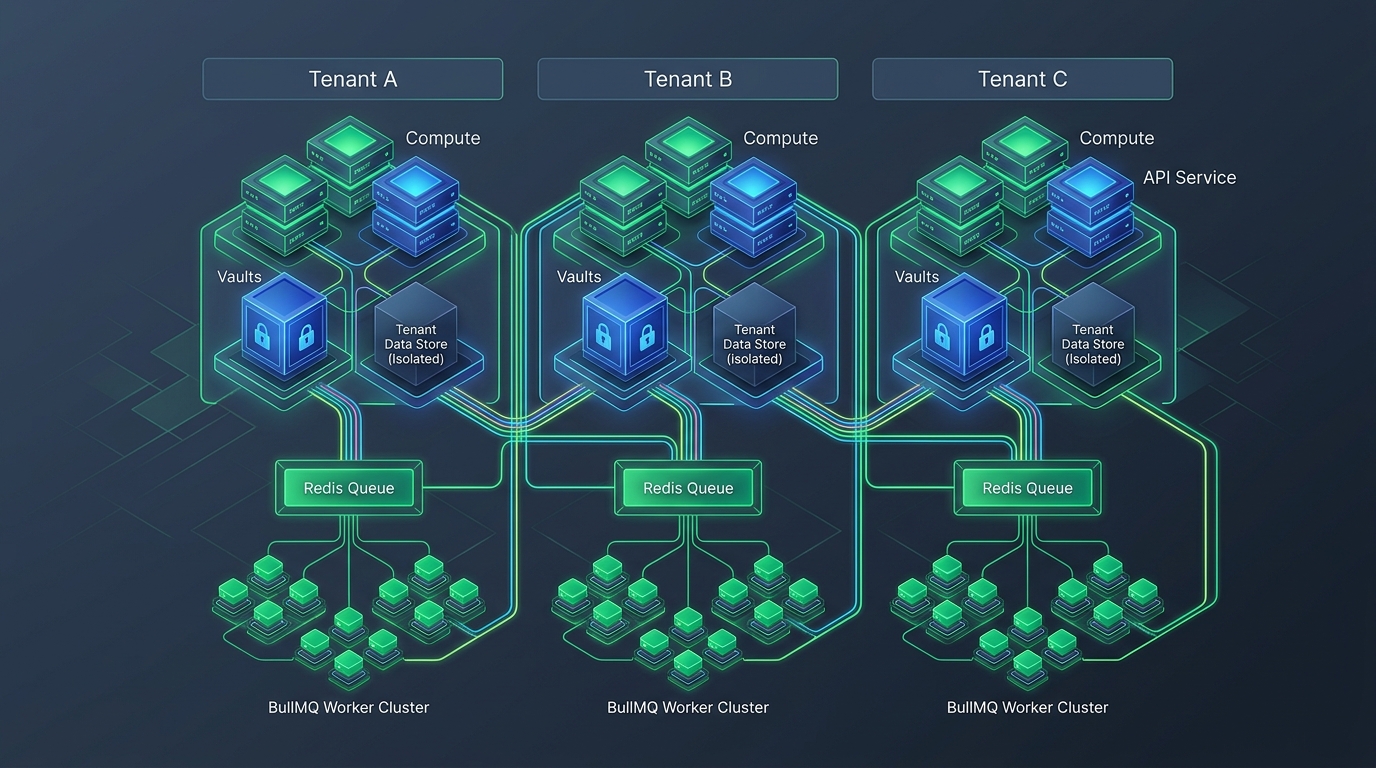
If an e-commerce tenant broadcasts 50,000 flash sale templates at 12:00 PM, their resulting wave of 20,000 incoming customer responses must never monopolize the worker event loop or starve single-turn customer inquiries on another tenant.
2. Cross-Tenant Context Contamination
Under heavy multi-threaded event concurrency, asynchronous race conditions, improper memory caching, or shared RAG vector indices must never permit Tenant A's customer dialogue to bleed into Tenant B's prompt generation context.
3. Meta WABA Rate Limit Contagion
Meta enforces strict phone number messaging tiers (Tier 1: 1,000/day up to Tier 4: unlimited). If one client triggers rate-limit backpressure, the backoff delays must isolate completely without throttling global system egress.
4. Plaintext Secret & Token Leakage
Meta Permanent System User Access Tokens, Stripe credentials, and Paystack secret keys must never be stored in plaintext or exposed across application logs, database dumps, or shared process memory.
2. The DARA Cloud Isolation Topology
To eliminate these risks mathematically, DARA Cloud enforces isolation across three distinct architectural planes: Compute, Session Memory, and Ingress Queueing:
3. Cryptographic Secret Isolation (AES-256-GCM)
Every tenant connects their own Meta WhatsApp Business Account by providing a permanent System User Token. Storing these credentials in plaintext database columns is a severe vulnerability. DARA Cloud employs an Envelope Encryption Pattern:
Because the tenantId is cryptographically bound into the AES-256-GCM authentication tag as Additional Authenticated Data (AAD), a compromised ciphertext cannot be decrypted under another tenant's identity, preventing token tampering attacks entirely.
4. Two-Tier Session State Architecture
Conversational continuity requires retrieving past dialogue context in milliseconds. Querying traditional disk-based relational tables for every user turn produces fatal I/O bottlenecks. DARA Cloud employs a two-tier state pattern:
- Hot Layer (Redis Cluster): Active 24-hour sessions reside in isolated key namespaces:
dara:tenant:{tenant_id}:session:{phone_number}. Every state change is serialized via atomic Redis Lua scripts with automatic TTL expiration matching Meta's 24-hour customer service window. - Cold Layer (PostgreSQL with pgvector): Knowledge base vectors, completed customer transactions, and order history are persisted in PostgreSQL with strict Row-Level Security (RLS) policies enforcing
tenant_id = current_setting('app.current_tenant_id').
5. Decoupled Ingress & BullMQ Worker Pools
When Meta fires an inbound message webhook, the ingress controller performs zero heavy computation. It validates the SHA256 HMAC signature, serializes the payload into a BullMQ tenant queue, and immediately returns HTTP 200 OK within 70 milliseconds:
6. Solving WhatsApp Out-of-Order Messages with Debounce Locks
African mobile users frequently send fragmented thoughts in rapid succession:
- "Hello" (0.0s)
- "Do you have the Nike air force 1" (1.2s)
- "In size 43 and black color" (2.4s)
If three independent worker threads process these concurrently, the LLM will reply out-of-order, producing an embarrassing user experience. DARA Cloud solves this using Per-User Redis Debounce Locks:
7. Programmatic WABA Tier Scaling (Tier 1 to Tier 4)
Meta enforces progressive messaging limits to protect ecosystem health. DARA Cloud automatically monitors quality scores and regulates outbound template bursts to fast-track tenant progression:
| Messaging Tier | Daily Unique Limit | DARA Concurrency Target | Typical Upgrade Window |
|---|---|---|---|
| Tier 1 (Starter) | 1,000 customers / 24h | 15 msg/sec | Day 1 to Day 7 |
| Tier 2 (Growth) | 10,000 customers / 24h | 40 msg/sec | Day 7 to Day 14 |
| Tier 3 (Scale) | 100,000 customers / 24h | 100 msg/sec | Day 14 to Day 28 |
| Tier 4 (Enterprise) | Unlimited Daily Volume | 250+ msg/sec | Verified High-Volume Brands |
For Builders, Devs, Digital Agencies, Freelancers, Automation Experts & Entrepreneurs
Whether you are building custom WhatsApp AI agents for clients, scaling a digital automation agency, or deploying bespoke enterprise infrastructure, plug directly into the DARA Cloud ecosystem:
- Join the DARA Cloud Builders WhatsApp Community: Connect with fellow software developers, automation experts, digital agencies, freelancers, and entrepreneurs sharing Visual Flow templates, Copilot prompts, and client opportunities.
- Book an Enterprise Consultation: Need a custom multi-tenant deployment, dedicated Meta WABA provisioning, ERP/CRM integration, or custom analytics dashboard? Submit our Enterprise Consultation form or schedule a 30-minute architecture call.
- Start Building Free on DARA Cloud: Access the Visual Flow Builder, DARA Copilot, Real-Time Simulator 2.0, and pgvector RAG engine with 100 free starter credits.
Build on DARA Cloud or Request an Enterprise Consultation
Join our WhatsApp community for Builders, Devs, Digital Agencies, Freelancers & Automation Experts, or book a dedicated Enterprise Consultation with our solutions architects.
8. Technical Architecture FAQ
9. Related Technical Guides
Continue exploring DARA's distributed architecture and operational playbooks: